Behind Closed Doors: Independent Councillors Slam Action Gatineau’s Voting Bloc Dominance

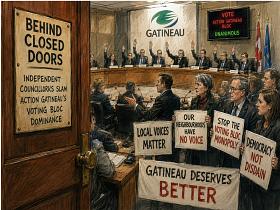
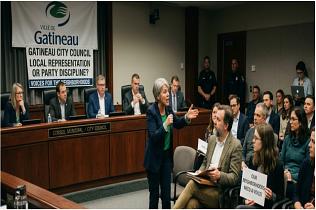

The battle for local democracy is being waged in the hallways of Gatineau's City Hall, although it's not very loud. A coalition of independent city councillors has made it public, after a lot of controversy, that the majority party Action Gatineau faces criticism for the costs of urban planning and municipal services. They claimed that the political machine has a very limited level of dominance over the votes and can trample local neighbourhoods' needs. The constant squabbling has revealed a vast gulf in ideology between the chiefs of the two parties - and council meetings have become a regular routine in which the independent councillors have alleged they have been deliberately side-lined from decision-making by party voting.
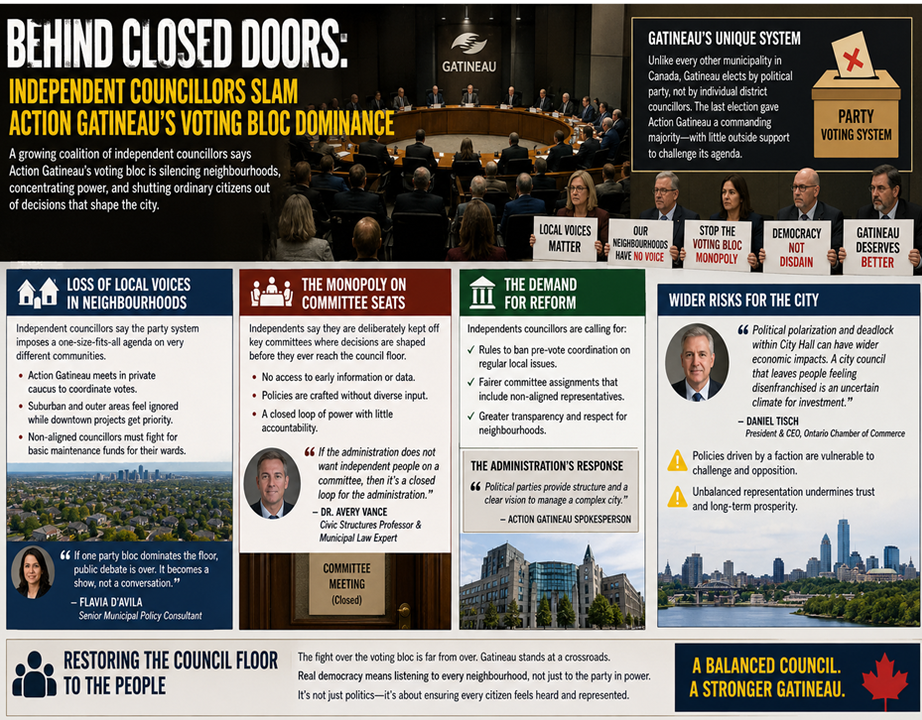
Unlike all other municipalities in Canada, Gatineau has no local councillor elected by the electorate of the district, but rather a unique municipal party system depending on the needs of the district. They have done so and established a balance which was badly skewed last time around when they defeated the opposition that gave the ruling party little outside support to pull through with its controversial policies. Independent Councillors state that it is actively blocking real debate in the parish with areas of the city having no voice at the decision making table.
Loss of local voices in neighbourhoods
The biggest grievance of the independents is that the party system forces a centralized (and packaged) agenda onto completely different communities. Action Gatineau is a group comprised of members who get together behind closed doors, prior to the public meeting, to coordinate their votes on a local road project, zoning change or neighbourhood safety issue.
This is a continuous harmony that has resulted in the widespread dismay in the suburbs and outer boroughs that there is such a contrast between what communities want and the integrated party leadership's vision. Non-aligned delegates indicate that they often have to plead with the council for simple maintenance money for their wards, before it is cut and spent on flagship projects chosen by the executive committee that are downtown.
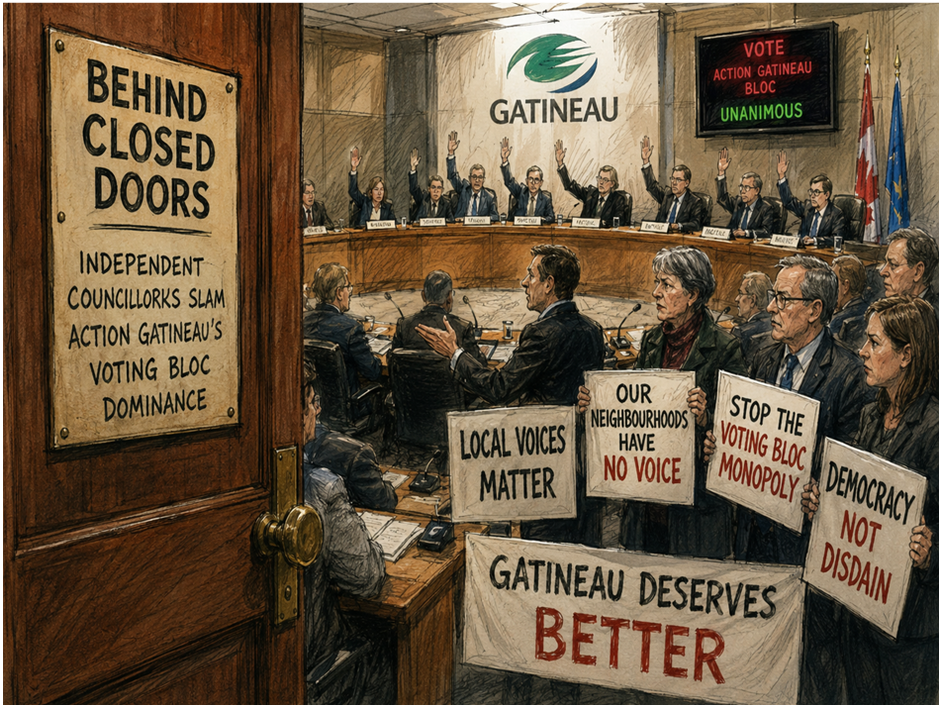
Local government experts say the principle of city council that is, to represent the neighbourhoods – is being betrayed by party loyalty. The overall imbalance is a very big shift that is reshaping the city, says Flavia d'Avila, a senior municipal policy consultant.
“What's supposed to happen, d'Avila explains, is that the municipal council should cover different neighbourhoods, and each of them has their own set of issues. If one party bloc dominates the floor then the public debate is over, an independent councillor can talk passionately for the people of his/her ward, but if the party has already made its decision in a private caucus, then the public debate is simply a show. The risk with this is that public debates can be restricted to sub-divisional or independent wards if they need to pay taxes but don't have any say in return “.
The Monopoly on Committee Seats
The main council floor isn't the only place in which independent voices are excluded. Non-aligned members are starting to recognize a coordinated effort to keep them from being part of key municipal committees and commissions, before policies are finalized.
Independent representatives say there is a big lack of accountability within this centralization of power. The ruling bloc can easily squander any real threat to their policy because they are anticipating the election and they have control of the internal committees; the non-aligned members operate in a vacuum, devoid of the important early stages of the policy process, data and information.
Civic structures professor and municipal law expert Dr. Avery Vance says there are long-term risks to having a monopoly on a city's administration.
“If the administration does not want independent people on a committee, then it's a closed loop for the administration,” Dr. Vance says. If decisions are taken with a strict partisan view, City Hall starts to separate itself from the life of the majority of non-party citizens in non-party communities, and a party consensus isn't the only one used to come to a decision.
The Cry for Real Reform
Independent councillors are trying to organise a campaign for transparency but the people are becoming more frustrated with the fact that issues are being ignored locally. They're calling for new regulations to allow no political party to hold pre-votes on regular local issues and want more balanced committee assignments so that non-aligned local districts are represented.
The administration has dismissed such grievances, arguing that political parties offer "structure and a clear coherent vision in a complex city budget. They think that at the municipal level whenever they elect an executive they make it clear to the candidate what they want him or her to do and are giving him or her a mandate to do it efficiently.
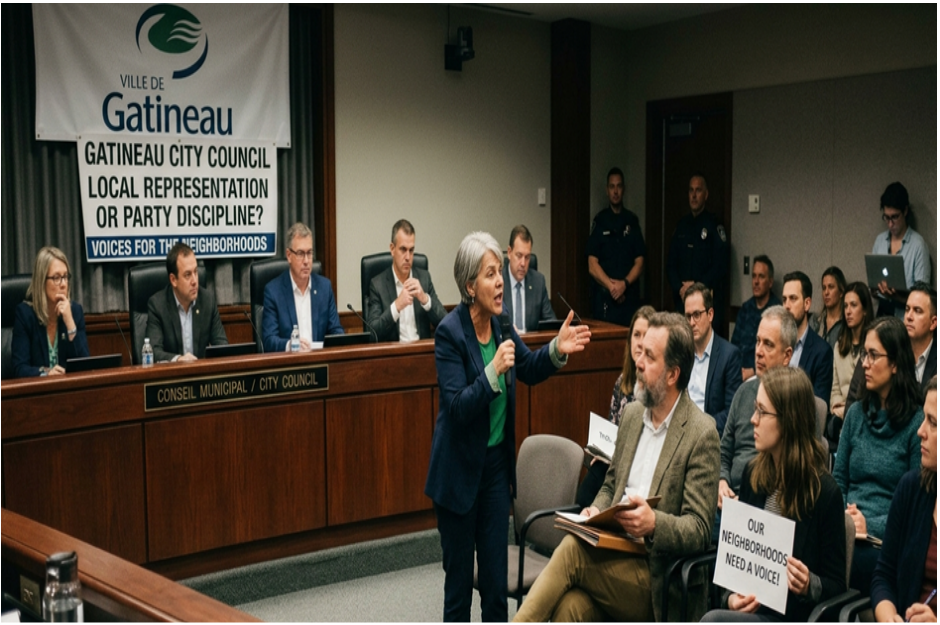
Daniel Tisch is President and Chief Executive Officer of the Ontario Chamber of Commerce and is monitoring how well regional government and public infrastructure works in the National Capital Region. Political polarization and deadlock within a city hall can have wider economic impacts," he says.
“But a city council that is so polarized, that significant portions of the population feel utterly disenfranchised, that they feel no one represents them is an uncertain climate for investment, Tisch says. Policies and infrastructure designs, if driven by a part of the community, are vulnerable to challenge and opposition in the next political cycle and risky investments in business and infrastructure”.
Reclaiming the Council Floor
The battle for control of the voting bloc is only just beginning and it's obvious that Gatineau's political ethos is in a state of flux.
Trust and respect in the credibility of Gatineau's municipal government will depend on City Hall's ability to get off the party platforms and truly acknowledge and respect independent voices. Balancing the council chamber is a political issue, but it's also a human issue; it's also how an ordinary citizen feels that the council member he or she supports can make a difference in how the council functions.